
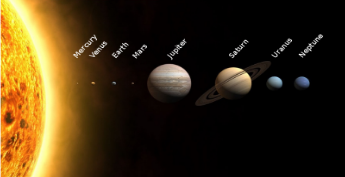
The solar system is the area in which we live. It contains billions of stars, the sun, and the eight planets plus moons, dwarf planets, comets, and asteroids. The universe was born in an explosion called the Big Bang, around 13.8 billion years ago. Before the Big Bang, our universe was nothing. The big bang wasn’t an explosion, the Big Bang was when the tiny universe expanded. After the Big Bang, the Big Bang grew really hot. After a second of the Big Bang, the universe started to cool down and started making matter. Next, the Big Bang started to make tiny particles called protons and neutrons began to form. Many thousands of years later, the universe had cooled down. This is when atoms began to form. About 3 million years after, the first stars were formed by clumps of gas and dust. The universe continues to expand. 500 million years after the first galaxies form. Even now the universe is still expanding. There are eight main planets, Mercury, Venus, Earth, Mars, Jupiter, Saturn, Uranus, and Neptune. The planets are divided into two groups, Terrestrial and Jovian. Terrestrial planets include Mercury, Venus, Earth, Mars. They’re made out of rocky material, their surfaces are solid, and they don’t have rings. Jovian planets include Jupiter, Saturn, Uranus, and Neptune. They have multiple moons and they don’t have solid surfaces.
Sun: The Sun is a yellow dwarf star that’s made out of poison gases. Our sun is made out of gas, plasma, and hydrogen. The sun’s surface temperature is 9,752℉. Our sun may look close but it’s very far. It’s about ninety-three million miles away from the earth. The sunlight takes 8 minutes to travel to the earth and it takes 100,000 years for the core energy to travel to the surface of the sun. Our sun takes 240 million years to orbit the Milky Way. The sun is divided into six layers:
Corona: The corona is the outer atmosphere (A atmosphere is layers of gases surrounding a planet, moon, or the sun)
Of the sun. It extends many thousands of kilometers (miles).
Chromosphere: The word “chromosphere” is named after Greek root chroma (meaning color) The chromosphere is about 2000 km thick. The sun’s chromosphere is above the photosphere where the temperature can rise from 6000°C to about 20,000°C.
Photosphere: The photosphere is between 100 to 700 kilometers thick. The temperature in the photosphere is about 10,000 degrees F.
Consecutive zone: In the consecutive zone hot gas rises, cools, and then sinks back down again. This- movement carries energy from the core to the surface. The consecutive zone is about 200,000 km thick, and it has a temperature of 2000,000°C.
Radiative zone: The dense radiative zone is about 300,000 km thick. It has a temperature of 2 to 7 million degrees C. This is where energy takes a thousand years to travel.
Core: The core is like a nuclear reactor, where hydrogen is forced together to make helium. The core diameter is about 864,000 miles. It has a temperature of 27 million°F.
and the cord. Our sun is made of 92. 1% hydrogen (H2) and 7.8 helium (He). Sometimes dark patches appear on the sun, called sunspots or prominence.
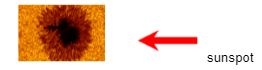
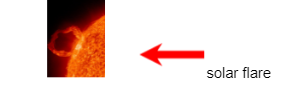
They look dark because they are about 3,500℉ cooler than the rest of the surface. They last only for a few weeks and are caused by the sun’s magnetic field. The sun is ten billion years old. It was born when a big cloud of dust and gas collapsed and then condensed and became our sun. If we didn’t have the sun, the planets would float away because the sun’s gravity is very strong that allowing it to hold the solar system. Our sun is the largest object in the solar system. The sun is so big that if it was empty all eight planets could fit inside it nearly six hundred times. Every so often solar flares erupt. A solar flare is an eruption of high-energy radiation blasts at the surface.
Fun fact: The sun can’t live forever, in about 6.5 billion years it will run out of hydrogen.
Fun fact: The sun has 99.8% of the mass in the solar system.
MERCURY: Mercury is named after the quick messenger of the Roman god. It’s named after the messenger of the Roman god because it’s the fastest planet to orbit the sun. It just takes 88 days to orbit the sun. Mercury was formed 4.5 billion years ago when gravity pulled swirling gas and dust together to form Mercury. Mercury is the smallest planet from the sun. At 3,032 miles and 4,879 km, across. This small planet is the second hottest planet. Its surface temperature can reach up to 806°F. Mercury revolves around the sun in an oval. When Mercury is closest to the sun it’s only about 29 million miles away from the sun and when it’s closer to the sun it speeds up to 128,000 miles per hour. When Mercury is farthest to the sun it’s only about 43 million miles from the sun and when it’s closer to the sun Mercury speed drops to only 87,000 miles per hour. Mercury doesn’t have a moon or any rings. Mercury has four layers.
Atmosphere: Mercury has a very dry, hot, and dusty surface. There is hardly any atmosphere to protect its surface from strong heat. Mercury’s atmosphere is made out of 42% of O2, 29% of Na, 22% of N2, and 7% of other gases. Mercury atmosphere is so thin that it’s invisible and the thinnest atmosphere of all the planets in the universe.
Crust: Mercury has a thin crust, thinner than earth. Unlike earth’s crust, which is broken into plates, Mercury’s crust is a single shell. Its crust is made mostly out of solid rocks and minerals. Mercury crust has been hit by comets. Its surface is covered with craters. Some astronomers believed that Mercury surface was smooth. They believe the sun would melt Mercury’s surface in the past.
Mantle: At only 370 miles 600 km deep. The Mercury Mantle is remarkably thin. Its Mantle is made out of silicate rock. Mercury mantle is about 100-700 km thick.
Core: Mercury’s core is made of iron. Scientists think Mercury’s outer part of the core might be liquid. Mercury core is about 310-390 km across. Mercury’s core is so big that it takes up about 85% of Mercury.
Mercury has been visited by two space crafts, NASA Mariner 10 and Messenger.